Judicial Council Approves Mandatory Reporting of Civil Arrests in Court Facilities
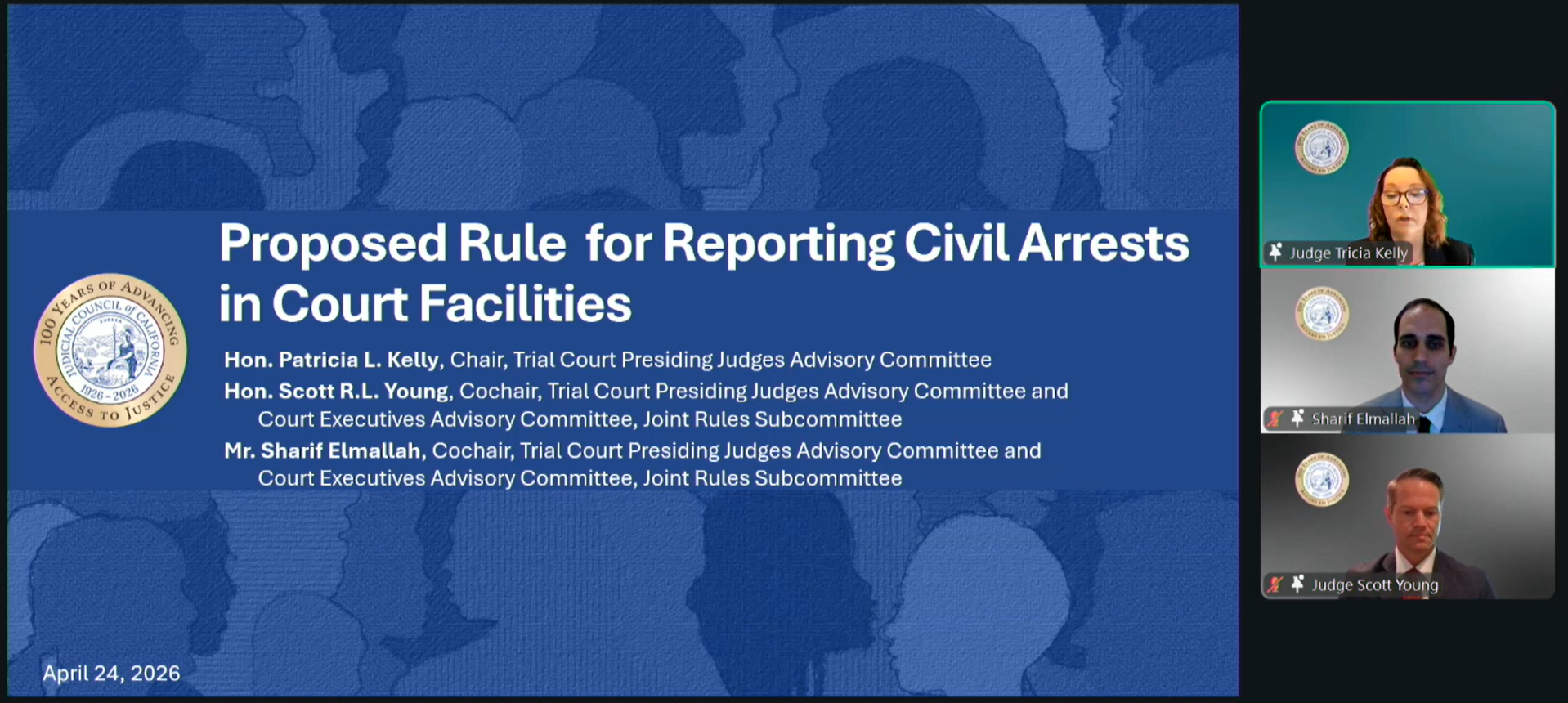
VIA WEB CONFERENCE—Judicial Council members approved a new rule at their April 24 business meeting that requires courts to report civil arrests—such as those related to federal immigration enforcement actions—that happen in superior court facilities.
The new rule aims to help the judicial branch better understand the impacts civil arrests in court facilities have on courts and access to justice and assist the branch in responding to court or community concerns.
Sharif Elmallah, court executive officer for the Butte Superior Court, told council members about an incident at the Oroville courthouse where federal agents conducted a day-long enforcement operation and took several people into custody.
“When people avoid court facilities out of fear, the court system cannot serve them and cannot function as intended,” said Elmallah, who also serves as co-chair of the council’s Trial Court Presiding Judges Advisory Committee and Court Executives Advisory Committee Joint Rules Subcommittee. “That affects the victim seeking protection under the law, witnesses whose testimony may be critical for parties to present their cases, and litigants who depend on their participation.”
The new rule says reports should include, if known, the location of the arrest at the court facility, the law enforcement agency that conducted the arrest, whether any individuals were taken into custody, and if the arresting officer presented a judicial warrant.
“The goal of rule 10.440 is data collection,” said Judge Scott R. L. Young, co-chair of the council’s Trial Court Presiding Judges Advisory Committee and Court Executives Advisory Committee Joint Rules Subcommittee. “The Judicial Council can and should understand where, and how, civil arrest activity occurs.”
The rule goes into effect May 1, and courts will start reporting the information on civil arrests in court facilities to the council in June. The council expects to start posting the information on a publicly available dashboard in July. Watch video of this agenda item
Other Items on Council Meeting Agenda:
Representation for Children and Families in Dependency Proceedings: The council approved redistributions of court-appointed juvenile dependency counsel funds for fiscal year 2025-26. The allocations promote equitable distribution of resources and support effective representation for children and families in dependency proceedings. After the initial proposal for allocating the unspent dependency counsel funding was submitted to the council, another court identified $150,000 for reallocation. A revised council report will reflect the updated amount of available unspent dependency counsel funding, which increases from $980,773 to $1,130,773. Watch video of this agenda item
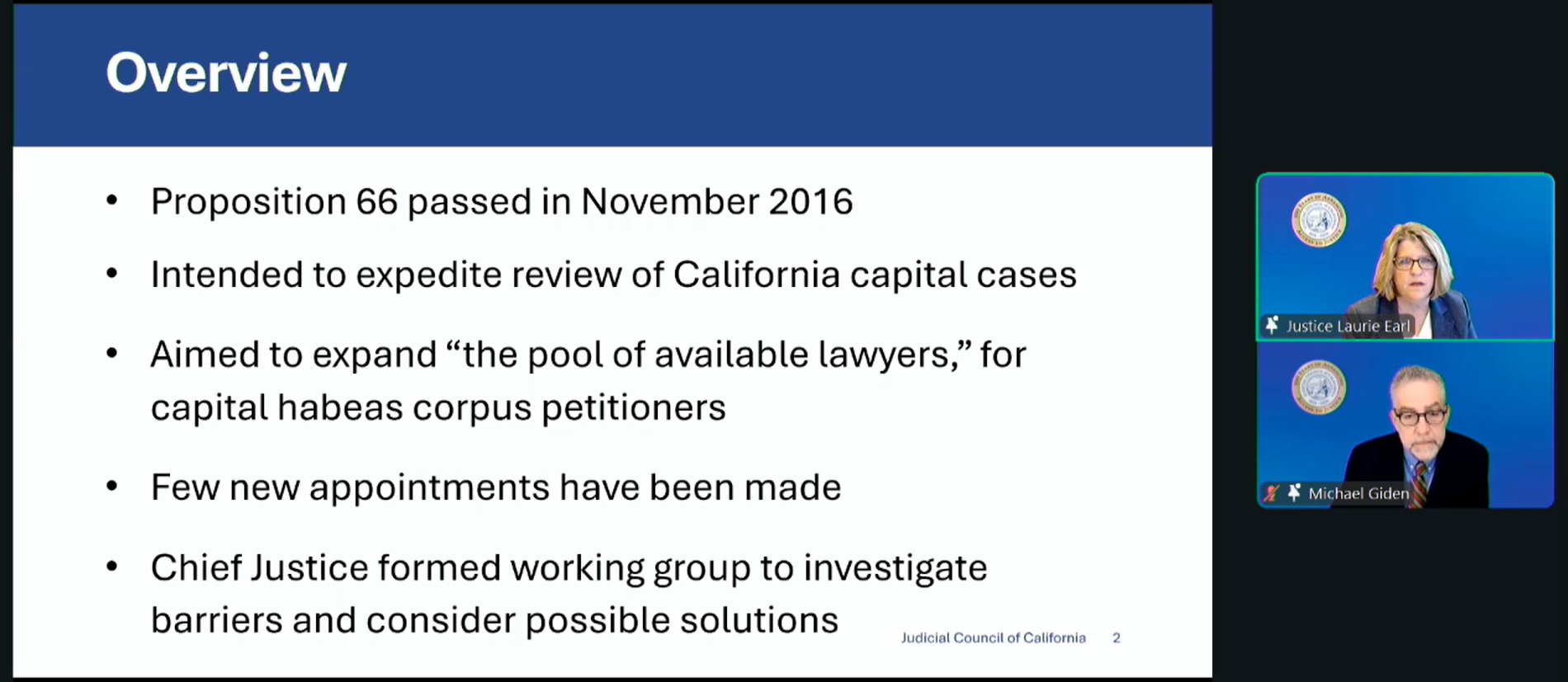
Appointment of Counsel in Capital Cases: The council received a report from the 2025 Proposition 66 Counsel Working Group, which examined the appointment of attorneys for petitioners in capital habeas corpus proceedings in both the superior courts and the Courts of Appeal. The report provides strategies judicial branch entities could use to recruit and appoint counsel for petitioners in such proceedings, which includes advocating for appellate counsel funding and reactivating regional committees to assist superior courts in their efforts to recruit attorneys to take these cases. Watch video of this agenda item
California Access to Justice Commission: The council heard a presentation from the California Access to Justice Commission on how for 30 years it has supported courts, the bar, and justice system stakeholders with research, reports, and support for the expansion of access to justice through legal services, self-help centers, navigators and small claims advisors, remote court services and proceedings, language assistance, libraries, and other community agencies and services. In addition, the council appointed Sacramento County Judge Andi Mudryk to one of the three positions on the commission appointed by the council. Watch video of this agenda item
Gender Inclusivity of Juror Identification and Juror Questionnaires: The council adopted a new standard of judicial administration to ensure gender inclusivity in juror identification and juror questionnaires per Assembly Bill 1899 (2024). The council also approved changes to existing rules of court, forms, and standards to ensure language directed to jurors is gender inclusive.
Report on Pretrial Programs: The council received the latest report on court pretrial programs and practices that promote safe, efficient, fair, and timely pretrial release of individuals booked into jail. The report includes data on bookings, release types, assessments conducted, the use of monitoring and supportive services, and case closure outcomes.
The complete meeting agenda and council reports are posted to the California Courts Meeting Information Center—an archived webcast of today’s meeting will be posted to the center as soon as it is available.
Images